
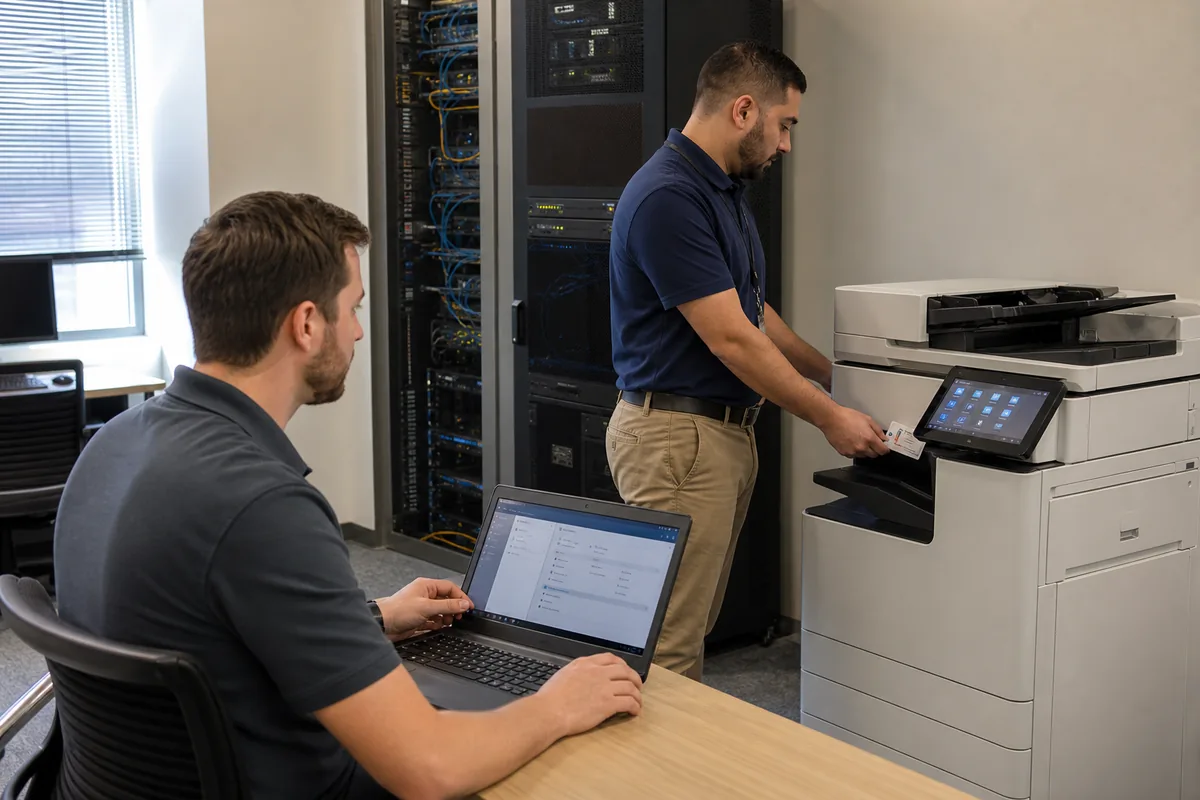
What security features should an office copier have?
Look for user authentication, secure print release, encrypted communication, protected stored data, signed firmware, administrative access controls, logging and a documented process for erasing information when the copier leaves.
Secure print and user authentication
PIN, badge or directory-based release keeps sensitive pages from sitting in the output tray. Role controls can limit color, scanning destinations and administrative changes. Test the workflow with real users before purchase.
Network and firmware security
Place the copier in the organization’s asset inventory. Confirm supported encryption, certificate management, protocol controls, firmware update process and vulnerability response. Disable unused services and change default credentials during installation.
Stored data and copier disposal
Ask whether the device has internal storage, what is encrypted and how overwrite or sanitization works. Put lease-return and disposal requirements in writing. Security features require configuration and ongoing administration; a feature listed on a brochure is not proof that it is enabled.
Compare copier brands using the same requirement
Do not decide this question from one manufacturer’s headline specification. Compare the relevant Canon copier families, Xerox copiers, Ricoh copier models, Sharp copiers and Konica Minolta copiers against the same monthly volume, paper, scanning, finishing, security and support brief. The local provider’s configuration and service capacity can matter as much as the logo on the machine.
Ask each provider to explain how the proposed device answers what security features should an office copier have. Require the answer in the itemized proposal, including any option, accessory, service assumption or contract term needed to make it true.
Turn the research into comparable office copier quotes
Write down average and peak page volume, regular users, color percentage, required media, scan destinations, finishing and service expectations. Then use the office copier price comparison form so providers respond to one consistent requirement. Recheck unfamiliar contract language in the 2026 office copier answer library before signing.
Common copier comparison mistakes to avoid
- Comparing an advertised base machine with a fully configured proposal.
- Using maximum duty cycle as if it were recommended monthly volume.
- Combining equipment financing and service into one unexplained payment.
- Ignoring installation, network setup, training and lease-end responsibilities.
- Choosing a model before documenting real print, scan, paper and finishing work.
The goal is not to make every proposal identical. It is to make every difference visible. A provider may recommend another speed, platform or service structure, but the proposal should explain why that change better answers the same business requirement.
Keep the final configuration sheet, service schedule and contract exhibits together. Those documents become the baseline for installation approval, future billing checks, service escalations and the next replacement decision.
- PIN, badge or directory authentication
- Encrypted print and scan traffic
- Signed firmware and update process
- Administrative role controls
- Audit and usage logs
- End-of-life data sanitization
Put this answer into a complete copier decision
Use this topic with the complete Office Copier Buyer’s Guide, the office copier authority answer library, current copier brand guides and the local copier pricing directory. Compare the same workload, configuration and service assumptions in every proposal.
Turn the answers into a useful copier quote.
Describe volume, paper, scanning, finishing and service needs once.